 https://auction.ridesafely.com/images/2027/07/auction-damage-codes-banner.jpg
865
1440
RideSafely
/images/2025/01/ridesafely-logo.svg
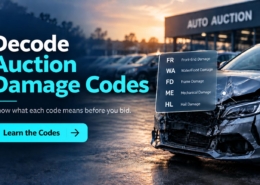
RideSafely2026-09-15 10:49:542026-09-15 13:09:23How to Decode Auction Damage Codes
https://auction.ridesafely.com/images/2027/07/auction-damage-codes-banner.jpg
865
1440
RideSafely
/images/2025/01/ridesafely-logo.svg
RideSafely2026-09-15 10:49:542026-09-15 13:09:23How to Decode Auction Damage CodesInternational buyers can access one of the largest used vehicle markets in the world through U.S. car auctions, which include used cars, repairable vehicles, salvage vehicles, and luxury models, all of which can be searched online from any location.
Access is not the same in all cases. Some auctions will take international bidders directly, while others require you to have a dealer’s licence, produce business documentation, or go through a registered broker. Before you submit a bid, you should compare the access requirements, the inventory, the fees, the types of title offered, and the export support, not just the price.
Best U.S. Auctions for International Buyers, at a Glance
- RideSafely: best overall if you don’t hold a U.S. dealer’s license
- Copart: best for inventory size, vehicle variety, and established export logistics
- IAA: best for insurance, damaged, and repairable vehicle specialists
- Manheim: best for licensed dealers buying wholesale
- ACV Auctions: best for dealerships that want digital condition reports and bidding tools
Why Overseas Buyers Choose U.S. Car Auctions
Suppose you want a late-model hybrid SUV but there aren’t many available in your home market. Thousands of these vehicles are listed online at U.S. auctions, having been obtained from insurance companies, rental fleets, banks, and dealers, and in this way you’ll never need to go to a dealership.
The range of the categories is also very broad, including SUVs, pickups, luxury cars, electric vehicles, hybrids, and vehicles that can be repaired, across almost any budget and condition.
RideSafely: Auction Access Without a Dealer’s License
RideSafely is not an auction house but rather a type of intermediary platform which serves public buyers, both within and outside the United States, who wish to place bids on used, repairable and salvage vehicles without having to obtain a U.S. dealer’s license; the platform links you with auctions such as Copart, IAA and other major U.S. auction sources.
You are able to gain auction access to the inventory of major U.S. auction companies from a distance, which means that you can search, place bids, and complete your purchases using a single account rather than having to qualify with each auction house individually. This is the actual obstacle that the service eliminates, and the importance of this point is just as significant for individual buyers as it is for smaller international businesses.
RideSafely can also assist with shipping, which is more important than it may initially seem because vehicles usually have to be removed from the auction premises within a few days of being purchased; otherwise, storage fees may begin to accumulate.
Copart: Largest Inventory, Broadest Export Experience
Copart is one of the biggest online markets for vehicles in the United States and has listings for used cars, wholesale vehicles, those that can be repaired, and salvage vehicles at hundreds of locations.
Although international buyers are allowed to participate, the documentation required will vary depending on the type of vehicle and your buyer status. In some cases, business or dealer qualifications are required to access dealer-only auction inventory, and these requirements can be met through an authorized broker rather than by holding the qualifications yourself. Moreover, Copart operates its own international shipping network, which can be a significant benefit if you are exporting vehicles in large quantities.
This option is more suitable for experienced overseas buyers who are comfortable navigating auction classifications and licensing requirements when buying directly from Copart.
IAA: Deep Insurance and Salvage Inventory
IAA, which is now a part of RB Global, deals specifically with vehicles that are damaged, capable of being repaired, and used ones, mostly those obtained from insurance claims.
International buyers can enter the system through qualifying accounts or via registered brokers, and whether or not they are eligible depends on their location and the type of vehicle. Make sure you check your eligibility before making a deposit or arranging transport.
It suits rebuilders and those automotive businesses which obtain large quantities of repairable stock.
Manheim: Built for Licensed Dealers
Although Manheim is a major wholesale marketplace, its main auctions are open only to licensed dealers and to qualified commercial buyers. Overseas inpiduals generally cannot participate as they would at a public auction.
International automotive companies with the necessary qualifications might consider the wholesale inventory worthwhile, but the hurdle to entering the U.S. auction market is very great for those who are new to it. Private buyers are generally more adequately served by a platform which provides broker-supported access.
ACV Auctions: Dealer-to-Dealer Marketplace
ACV Auctions specializes in dealing with wholesale transactions between automotive professionals and provides digital condition reports and online bidding facilities that are designed for use by dealership buyers.
This would suit a qualified dealership importing from the U.S. Still, private buyers based overseas should check the access requirements first, since dealer-focused platforms like this generally have more stringent participation rules than public auctions.
What to Check Before You Bid
The fact that the winning bid is low does not ensure that the purchase will be profitable. Four factors are more important than the final hammer price:
- The type of title has different restrictions: for example, salvage, rebuilt, parts-only, export-only and clean titles are all subject to such restrictions. You should check this before placing a bid, not after.
- As for condition and history, when cars are put up for auction they are usually sold without any repairs, so you should allow for the possibility that the condition described in the listing may not be complete.
- The total landed cost refers to the winning bid together with the buyer’s fees, any broker’s fee, inland transport to the export port, ocean freight, customs duties, and destination taxes. On major public platforms, buyer fees are generally structured in tiers: a fixed amount for lower bid amounts, changing to a percentage of the bid as the price increases, plus a smaller online-bidding fee and a separate gate or documentation charge per vehicle. Exact fees vary by location and membership type and may change with little notice, so check the current fee schedule on the auction website before bidding.
- The vehicle’s eligibility for import depends on your country’s regulations concerning its age, emissions, steering position, title status, and the classification of any damage, since these factors all influence whether the vehicle can enter legally. Check this point before placing your bid, not after you have won.
Shipping: Price It Before You Bid
After winning an auction, vehicles generally have to be collected within a few days or else storage fees will begin to accumulate. Before placing your bid, get a transport quote, not afterward. You should also take distance into account, since a less expensive car located far inland may end up costing more than a more expensive one parked near a major export port.
Examples of export gateways are the ports in New York/New Jersey, Savannah, Houston, Miami, and Los Angeles.
RoRo (roll-on/roll-off) is generally the cheaper method for transporting a standard, drivable vehicle. In contrast, container shipping is more expensive but provides extra protection and is the only option for non-running vehicles, classics, or when shipping parts together. Since rates are affected by fuel surcharges, the time of year, and the route, treat any online quote as an initial estimate, not the final figure.
Which Auction Should You Use?
Your choice should be based on your experience, budget, qualifications, and the kind of vehicle you want; it is more important than picking the one with the lowest average price.
A U.S. dealer’s license need not be held if you use RideSafely or other broker-supported platforms, since these enable you to access inventory from the major auction companies via a single account. For an experienced buyer who is willing to look after the matter of licensing and classification on their own, Copart’s range of inventory and its export facilities are difficult to beat. If you need repairable or insurance-sourced vehicles specifically, then IAA is the better option. Manheim and ACV Auctions should only be considered if you have already obtained dealer or commercial buyer status, since both of them are based on wholesale trading rather than on individual purchases.
Final Thoughts
Overseas buyers can access a much wider variety of cars at U.S. auctions than is generally available in local markets, usually at competitive prices. However, the cost savings come from careful preparation, not just from making a good bid.
Before placing your bid, make sure you have access to the auction, check the title, total up the fees, work out the cost of shipping, and confirm that your country’s import regulations cover the particular vehicle you are interested in. After that, choose a platform that suits your experience level and eligibility, not just the one with the largest inventory.
If you do not have a U.S. dealer’s license, RideSafely will handle obtaining access for you. You can review the current inventory to see what is available before you choose a platform.
Frequently Asked Questions
Can international buyers purchase cars from U.S. auctions?
Yes, many U.S. car auctions let international buyers join online. But each auction and vehicle may have different rules. Some sites ask for a dealer license, business paperwork, or a registered broker. Before you bid, check if you qualify, what titles are allowed, how to pay, and what export steps are needed.
Do overseas buyers need a U.S. dealer license to bid at car auctions?
Not always. Some online car auctions let overseas buyers purchase cars without a U.S. dealer license. Others allow only licensed dealers or businesses to buy certain vehicles. In those cases, you might need to work with an authorized broker. Be sure to review the auction’s rules before you bid.
What costs should international buyers expect when buying from a U.S. car auction?
International buyers need to plan for more than just the winning bid. Usual costs include auction and broker fees, transport within the U.S., port charges, shipping, customs duties, taxes, and local registration. If you don’t pick up the car quickly, storage fees can add up. Figure out the total cost before you bid to avoid surprises.
Can salvage cars purchased at U.S. auctions be exported overseas?
Yes, many salvage cars can be shipped out of the United States. But each country has its own import rules. Some places limit certain titles, car ages, damage types, or emissions. Check your country’s import laws before you bid, since a car you can export from the U.S. might not be allowed for use where you live.
What is the best U.S. car auction for international buyers?
The best U.S. car auction for you depends on your experience, paperwork, and what kind of car you want. Copart and IAA have lots of options, while dealer-only sites work better for businesses. If you don’t have a U.S. dealer license, you might like broker-supported sites like RideSafely, which make it easier to join online auctions.
What People Are Saying

You might also like
https://auction.ridesafely.com/images/2027/07/auction-damage-codes-banner.jpg
865
1440
RideSafely
/images/2025/01/ridesafely-logo.svg
RideSafely2026-09-15 10:49:542026-09-15 13:09:23How to Decode Auction Damage Codes https://auction.ridesafely.com/images/2026/09/popular-salvage-vehicles-by-category-banner.jpg
972
1619
RideSafely
/images/2025/01/ridesafely-logo.svg
RideSafely2026-09-08 11:58:462026-09-08 13:12:02The Most Popular Salvage Vehicles by Category
https://auction.ridesafely.com/images/2026/09/popular-salvage-vehicles-by-category-banner.jpg
972
1619
RideSafely
/images/2025/01/ridesafely-logo.svg
RideSafely2026-09-08 11:58:462026-09-08 13:12:02The Most Popular Salvage Vehicles by Category https://auction.ridesafely.com/images/2026/09/front-end-damage-cars-at-auction-worth-buying.jpg
865
1440
RideSafely
/images/2025/01/ridesafely-logo.svg
RideSafely2026-09-01 12:39:592026-09-01 13:10:42Front-End Damage Cars at Auction: Worth Buying?
https://auction.ridesafely.com/images/2026/09/front-end-damage-cars-at-auction-worth-buying.jpg
865
1440
RideSafely
/images/2025/01/ridesafely-logo.svg
RideSafely2026-09-01 12:39:592026-09-01 13:10:42Front-End Damage Cars at Auction: Worth Buying? https://auction.ridesafely.com/images/2026/08/rear-end-damage-cars-banner.jpg
865
1440
RideSafely
/images/2025/01/ridesafely-logo.svg
RideSafely2026-08-25 11:10:002026-08-25 13:29:41Rear-End Damage Cars: Easier to Repair Than You Think?
https://auction.ridesafely.com/images/2026/08/rear-end-damage-cars-banner.jpg
865
1440
RideSafely
/images/2025/01/ridesafely-logo.svg
RideSafely2026-08-25 11:10:002026-08-25 13:29:41Rear-End Damage Cars: Easier to Repair Than You Think? https://auction.ridesafely.com/images/2026/08/best-us-car-auctions-overseas-buyers-banner.jpg
865
1440
RideSafely
/images/2025/01/ridesafely-logo.svg
RideSafely2026-08-18 12:42:212026-08-18 13:53:28Best U.S. Car Auctions for Overseas Buyers
https://auction.ridesafely.com/images/2026/08/best-us-car-auctions-overseas-buyers-banner.jpg
865
1440
RideSafely
/images/2025/01/ridesafely-logo.svg
RideSafely2026-08-18 12:42:212026-08-18 13:53:28Best U.S. Car Auctions for Overseas BuyersYour RideSafely Questions, Answered
From auction to driveway — we’ve got you covered.
Leave a Reply
Want to join the discussion?Feel free to contribute!