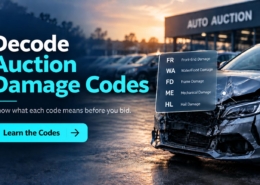
 https://auction.ridesafely.com/images/2027/07/auction-damage-codes-banner.jpg
865
1440
RideSafely
/images/2025/01/ridesafely-logo.svg
RideSafely2026-09-15 10:49:542026-09-15 13:09:23How to Decode Auction Damage Codes
https://auction.ridesafely.com/images/2027/07/auction-damage-codes-banner.jpg
865
1440
RideSafely
/images/2025/01/ridesafely-logo.svg
RideSafely2026-09-15 10:49:542026-09-15 13:09:23How to Decode Auction Damage CodesBuying a vehicle through an online auto auction can be incredibly rewarding, but it also requires more research than purchasing a car from a traditional dealership. Auction listings often provide dozens of photos, basic specifications, and a damage description, yet one of the most valuable pieces of information is frequently overlooked: the Vehicle Identification Number (VIN). Those 17 seemingly random characters can reveal critical information about a vehicle long before you place your first bid.
Whether you’re searching for a repairable sedan, a family SUV, a luxury vehicle, or a pickup truck, VIN decoding helps verify that the vehicle you’re looking at matches what the manufacturer originally built. It gives buyers confidence, helps identify inconsistencies, and reduces the chances of expensive surprises after winning an auction.
The good news is that VIN decoding isn’t complicated. Government resources and trusted VIN decoder tools make it possible to verify factory information within seconds. When combined with auction photos, condition reports, and vehicle history information, a VIN becomes one of the most powerful research tools available to any auction buyer.
What Is VIN Decoding and Why Does It Matter?
Every passenger vehicle manufactured for sale in the United States since the 1981 model year carries a unique 17-character Vehicle Identification Number. Federal regulations require this standardized format, making every VIN a permanent identifier for an individual vehicle. The VIN also includes a mathematical check digit that helps validate its authenticity.
Understanding the 17-Character Vehicle Identification Number
Think of a VIN as a vehicle’s fingerprint. No two qualifying vehicles share the same VIN, and every character serves a specific purpose. Rather than being assigned randomly, manufacturers encode details such as the manufacturer, model, body style, engine configuration, model year, assembly plant, and production sequence directly into the VIN.
Because VINs follow an international standard, buyers can decode vehicles from virtually every major manufacturer using the same principles. This consistency is especially valuable at salvage and insurance auto auctions, where listings may contain hundreds or even thousands of vehicles from different brands.
What Information a VIN Can Reveal
A quality VIN decoder can reveal information including:
| Information Available | Why It Matters |
|---|---|
| Manufacturer | Confirms vehicle origin |
| Model year | Verifies auction listing accuracy |
| Engine type | Helps estimate repair costs |
| Body style | Confirms original configuration |
| Drive type | Identifies FWD, RWD, AWD, or 4WD models |
| Assembly plant | Verifies production details |
| Safety equipment | Useful when sourcing replacement parts |
The official NHTSA VIN Decoder provides much of this information directly from manufacturer-submitted data, making it an excellent starting point for buyers.
Why VIN Checks Are Essential Before Bidding
Auction buyers often focus on visible damage, but the largest financial surprises usually come from details that aren’t immediately obvious. VIN decoding fills many of those knowledge gaps before money is ever committed.
Confirming Vehicle Identity
Auction listings occasionally contain minor errors. A typo in the trim level, engine size, drivetrain, or production year may seem insignificant, but those differences can dramatically affect vehicle value and repair costs.
For example, two SUVs may appear nearly identical in auction photos. One could have a naturally aspirated engine while another uses a turbocharged powertrain with significantly different replacement parts. Without decoding the VIN, buyers may mistakenly assume they’re bidding on the same configuration.
VIN decoding also helps ensure that auction photos match the actual vehicle. If the decoded body style, engine, or drivetrain differs from what appears in the listing, that’s a signal to investigate further before placing a bid.
Avoiding Costly Listing Mistakes
Imagine budgeting for repairs on a vehicle believed to have cloth seats and standard headlights, only to discover after purchase that it was factory-equipped with premium LED lighting, adaptive safety systems, or specialized electronic components.
Those options can significantly increase repair costs.
VIN decoding provides an objective reference point. Rather than relying solely on listing descriptions, buyers can compare manufacturer specifications against the auction listing and adjust their bidding strategy accordingly.
Breaking Down the VIN Character by Character
Although most buyers never need to memorize every VIN position, understanding its structure helps explain why decoding is so valuable.
World Manufacturer Identifier (WMI)
The first three characters identify the manufacturer and vehicle type.
This immediately confirms whether the vehicle truly originated from the manufacturer shown in the auction listing. It also identifies the country or region where the manufacturer is registered, making it easier to validate imported vehicles.
Vehicle Descriptor Section (VDS)
Characters four through eight describe important vehicle attributes, including body configuration, restraint systems, engine type, and other manufacturer-specific details.
These characters are especially valuable when ordering replacement parts after winning an auction because they help distinguish between similar-looking trims that use different components.
Vehicle Identifier Section (VIS)
The final portion includes the model year, assembly plant, and unique production serial number.
Position nine serves as a check digit, allowing systems to verify whether the VIN has been entered correctly. Position ten identifies the model year, while position eleven identifies the manufacturing plant.
How VIN Decoding Helps Auction Buyers Avoid Costly Mistakes
VIN decoding becomes even more valuable when combined with careful inspection of auction photos and available documentation.
Verifying Factory Specifications
Many auction vehicles have aftermarket modifications. Wheels may have been upgraded, suspension components replaced, or entertainment systems changed.
The VIN reveals how the vehicle originally left the factory.
Knowing the original specifications helps buyers distinguish between factory equipment and aftermarket additions, making it easier to estimate both value and repair costs.
Comparing Auction Photos With VIN Data
Suppose a VIN identifies a vehicle as an all-wheel-drive model, but the auction listing describes it as front-wheel drive.
That discrepancy deserves attention.
Likewise, if the VIN identifies a four-cylinder engine but auction photos clearly show a different powertrain, additional verification should be performed before bidding.
Small inconsistencies don’t automatically indicate fraud, but they often justify asking questions or conducting further research.
Estimating Repair Costs More Accurately
Repair costs depend heavily on original equipment.
Luxury trim packages, advanced driver assistance systems, adaptive suspension, panoramic roofs, and premium lighting systems all increase replacement costs after a collision.
VIN decoding identifies many of these factory-installed features before purchase, allowing buyers to create more realistic repair budgets instead of relying solely on auction photos.
Identifying Potential Red Flags
Experienced auction buyers rarely rely on one source of information. They combine VIN decoding with condition reports, vehicle history information, and auction photos before placing a bid.
Instead, they compare:
- VIN decoding results
- Auction photographs
- Vehicle history reports
- Damage descriptions
- Title information
- Available inspection reports
When all of these sources align, buyers can bid with greater confidence. When they don’t, additional investigation may prevent an expensive mistake.
VIN Decoding vs. Vehicle History Reports
One common misconception is that VIN decoding replaces a vehicle history report.
It doesn’t.
Instead, these tools complement one another.
What Each Tool Does Best
| VIN Decoder | Vehicle History Report |
|---|---|
| Factory specifications | Ownership history |
| Engine configuration | Accident records (when reported) |
| Body style | Title brands |
| Model year verification | Odometer records |
| Manufacturing plant | Service history (where available) |
| Safety equipment | Auction history (provider dependent) |
VIN decoding answers the question:
“What did the manufacturer originally build?”
A vehicle history report answers:
“What has happened to the vehicle over time?”
Using both together provides a much more complete understanding before bidding.
Best Practices for Using VIN Information Before Buying
The most successful auction buyers follow a consistent research process rather than relying on instinct alone.
A Simple Pre-Bid VIN Checklist
Before placing any bid:
- Decode the VIN using an official or trusted VIN decoder.
- Verify the year, make, model, engine, and drivetrain.
- Compare decoded information with auction photos.
- Review available title information.
- Check for open safety recalls if applicable.
- Estimate repair costs using confirmed factory specifications.
- Compare the vehicle with similar auction listings before establishing your maximum bid.
This process typically requires only a few minutes but can prevent thousands of dollars in unexpected expenses.
As the National Highway Traffic Safety Administration (NHTSA) explains, the VIN is fundamental to accurately identifying vehicles and supporting recalls, vehicle registration, insurance, and safety investigations.
Common VIN Decoding Myths
Several misconceptions continue to circulate among first-time auction buyers.
One myth is that decoding a VIN reveals a vehicle’s complete accident history. It does not. A VIN decoder identifies the vehicle’s factory information, while accident and ownership history typically comes from separate databases.
Another misconception is that VIN decoding only matters for salvage vehicles. In reality, every auction vehicle benefits from verification. Even clean-title vehicles should have their factory specifications confirmed before purchase.
Some buyers also believe VIN decoding is only useful for mechanics or dealerships. Modern online VIN decoders make the process accessible to anyone, regardless of technical experience. In just a few seconds, buyers can verify critical information that would otherwise require extensive research.
Think of the condition report as the X-ray before surgery.
Conclusion
Successful auction buying starts long before the bidding begins. Along with VIN decoding, understanding online auctions helps buyers research vehicles more effectively before placing a bid. While photos, condition reports, and market values all play important roles, VIN decoding provides an independent way to verify exactly what a vehicle was when it left the factory.
By confirming manufacturer specifications, identifying inconsistencies, more accurately estimating repair costs, and supporting smarter bidding decisions, VIN decoding reduces uncertainty throughout the auction process. It won’t predict every repair or reveal every aspect of a vehicle’s history, but it creates a stronger foundation for informed buying decisions.
For anyone purchasing vehicles through online auto auctions, taking a few minutes to decode the VIN before bidding is one of the simplest and most valuable habits you can develop.
Frequently Asked Questions
What is a VIN decoder?
A VIN decoder is a tool that interprets a vehicle’s 17-character Vehicle Identification Number to identify manufacturer specifications such as the model year, engine, body style, drivetrain, assembly plant, and safety equipment.
Can VIN decoding tell me if a car has been in an accident?
No. VIN decoding identifies factory specifications. Accident history typically comes from vehicle history reports, insurance records, or auction history databases.
Is VIN decoding free?
Yes. The official NHTSA VIN Decoder is available to the public at no cost and provides manufacturer-submitted vehicle information.
Does every auction vehicle have a VIN?
Nearly every passenger vehicle manufactured for sale in the United States since 1981 has a standardized 17-character VIN, although damaged vehicles may require careful inspection to locate it.
Should I decode the VIN before every auction bid?
Absolutely. Even if the auction listing appears complete, decoding the VIN helps verify that the vehicle matches its factory specifications and supports more accurate repair estimates and bidding decisions.
What People Are Saying

You might also like
https://auction.ridesafely.com/images/2027/07/auction-damage-codes-banner.jpg
865
1440
RideSafely
/images/2025/01/ridesafely-logo.svg
RideSafely2026-09-15 10:49:542026-09-15 13:09:23How to Decode Auction Damage Codes https://auction.ridesafely.com/images/2026/09/popular-salvage-vehicles-by-category-banner.jpg
972
1619
RideSafely
/images/2025/01/ridesafely-logo.svg
RideSafely2026-09-08 11:58:462026-09-08 13:12:02The Most Popular Salvage Vehicles by Category
https://auction.ridesafely.com/images/2026/09/popular-salvage-vehicles-by-category-banner.jpg
972
1619
RideSafely
/images/2025/01/ridesafely-logo.svg
RideSafely2026-09-08 11:58:462026-09-08 13:12:02The Most Popular Salvage Vehicles by Category https://auction.ridesafely.com/images/2026/09/front-end-damage-cars-at-auction-worth-buying.jpg
865
1440
RideSafely
/images/2025/01/ridesafely-logo.svg
RideSafely2026-09-01 12:39:592026-09-01 13:10:42Front-End Damage Cars at Auction: Worth Buying?
https://auction.ridesafely.com/images/2026/09/front-end-damage-cars-at-auction-worth-buying.jpg
865
1440
RideSafely
/images/2025/01/ridesafely-logo.svg
RideSafely2026-09-01 12:39:592026-09-01 13:10:42Front-End Damage Cars at Auction: Worth Buying? https://auction.ridesafely.com/images/2026/08/rear-end-damage-cars-banner.jpg
865
1440
RideSafely
/images/2025/01/ridesafely-logo.svg
RideSafely2026-08-25 11:10:002026-08-25 13:29:41Rear-End Damage Cars: Easier to Repair Than You Think?
https://auction.ridesafely.com/images/2026/08/rear-end-damage-cars-banner.jpg
865
1440
RideSafely
/images/2025/01/ridesafely-logo.svg
RideSafely2026-08-25 11:10:002026-08-25 13:29:41Rear-End Damage Cars: Easier to Repair Than You Think? https://auction.ridesafely.com/images/2026/08/best-us-car-auctions-overseas-buyers-banner.jpg
865
1440
RideSafely
/images/2025/01/ridesafely-logo.svg
RideSafely2026-08-18 12:42:212026-08-18 13:53:28Best U.S. Car Auctions for Overseas Buyers
https://auction.ridesafely.com/images/2026/08/best-us-car-auctions-overseas-buyers-banner.jpg
865
1440
RideSafely
/images/2025/01/ridesafely-logo.svg
RideSafely2026-08-18 12:42:212026-08-18 13:53:28Best U.S. Car Auctions for Overseas BuyersYour RideSafely Questions, Answered
From auction to driveway — we’ve got you covered.
Leave a Reply
Want to join the discussion?Feel free to contribute!