 https://auction.ridesafely.com/images/2026/11/car-auction-on-approval-explained-banner.jpg
865
1440
RideSafely
/images/2025/01/ridesafely-logo.svg
RideSafely2026-11-03 11:09:302026-11-03 11:58:18What Does On Approval Mean at a Car Auction?
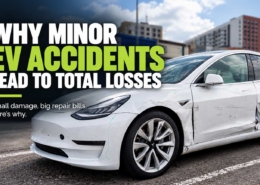
A small dent, a cracked bumper, or a damaged fender may seem like a straightforward repair. EVs, on the other hand, can be a completely different proposition after a crash.
Even minor damage can be very expensive to repair. In some cases, an insurer has written off an EV with only minor visible damage.
The explanation isn’t just about the cost of replacement parts. Battery protection, structural design, the need for specialist labor, and the manufacturer’s repair requirements all factor into the decision.
Knowing this helps the EV owner when making an insurance claim. It also helps a used EV buyer identify potential risks and opportunities.
Why Minor EV Accident Damage Can Be Misleading
The high-voltage battery is one of an EV’s most expensive components.
An EV traction battery differs greatly from a standard 12V battery. It’s a complex assembly of many cells, electrical connections, a cooling system, and various safety features.
Although manufacturers design these systems to be impact-resistant, certain impacts can still compromise the integrity of the protective enclosures.
Even if there’s no visible battery damage, techs may still do extra checks.
Possible issues include:
- Damage to the battery enclosure or mounting points
- Compromised high-voltage electrical connections
- Coolant leaks affecting the battery cooling system
- Physical deformation near battery modules
- Internal faults detected through diagnostic testing
Importantly, battery damage doesn’t necessarily mean you have to replace the whole pack.
Some manufacturers will allow certain repairs or component replacements. Others will restrict repairs depending on the nature of the damage and the battery design.
Per I-CAR’s high-voltage safety guidelines, collision repairs must follow the manufacturer’s specific inspection and safety procedures.
Repairability depends on the vehicle, the nature of the damage, and the availability of manufacturer-approved solutions.
Structural Damage Can Turn a Minor Collision Into a Major Repair
Electric cars frequently employ a reinforced underbody structure to protect the battery pack.
Some models also incorporate the battery pack into the structure.
As a result, damage in those areas can lead to complicated repair decisions.
For instance, a collision to the rocker panel could affect components that, in turn, protect the battery enclosure.
Although the outer panel may look repairable, you must also assess the base structure.
Other structural repairs will require special joining techniques, replacement sections, or manufacturer-approved equipment.
Not every damaged structural component can be straightened or repaired.
If the manufacturer insists on a replacement, then the labor and parts costs can easily balloon.
A car with fairly minor external damage can still end up with a surprisingly high repair bill.
EV Sensors and Electronics Add to Collision Repair Costs
Modern EVs rely heavily on electronics and advanced driver assistance systems.
These systems can include cameras, radar sensors, parking assist, automatic emergency braking, and lane-keeping.
A fairly minor front-end collision can affect their alignment or operation.
For example, fitting a new bumper may require further diagnostics and/or sensor calibration.
Furthermore, some electronic faults will still be invisible during a basic visual inspection.
Technicians may need specialist diagnostic equipment to identify the problem and confirm correct operation after the repair.
So the final bill can cover much more than body panels, paint, and standard labor.
These costs can rise even if the high-voltage battery is in perfect condition.
Specialized EV Repair Requirements Increase Labor Costs
Repairing an EV requires extra precautions for high-voltage components.
Before certain procedures, qualified technicians must follow the manufacturer’s instructions to safely de-energize and verify the electrical system.
Depending on the extent of the damage, repairs may also require removing the battery or a specialist inspection.
Furthermore, not every collision repair facility has the training or equipment to do high-voltage work.
As a result, some repairs will require specialist facilities or must be outsourced to a subcontractor.
These requirements will of course lead to higher labor costs and make the repair process more complicated.
However, specialist procedures serve a clear purpose: they let technicians properly assess and repair the damaged vehicle.
How Insurance Companies Decide an EV Is a Total Loss
An insurer will normally compare the cost of repair with the vehicle’s pre-accident value.
That value (commonly known as actual cash value) reflects age, mileage, condition, and market prices.
Depending on the applicable rules, the insurer may also consider the damaged vehicle’s salvage value.
Consider this hypothetical example:
| EV value before the accident | $25,000 |
| Estimated collision repairs | $17,000 |
| Estimated salvage value | $9,000 |
| Repairs plus salvage value | $26,000 |
Under a total loss formula, these figures would be sufficient to support declaring the vehicle a total loss. However, states have different rules, and insurers must follow the applicable rules and policy requirements.
Repair quotes can also change as engineers disassemble the car and find additional damage.
Depreciation also has a role.
As the car’s market value erodes, expensive repairs can make up a larger share of its value.
An older EV is therefore much more likely to be written off than a newer, more valuable model.
Does a totally written-off EV always have a damaged battery?
No. An EV can become an insurance total loss without any battery damage.
Expensive bodywork, damaged electronics, damaged structural components, and labor can all make a restoration uneconomical.
Similarly, a vehicle with a good battery could still have massive collision damage.
This matters because, from an insurance standpoint, a total loss doesn’t necessarily mean the vehicle is a write-off.
Instead, the designation may be down to repair economics rather than any actual mechanical failure.
Nevertheless, buyers must never assume a battery that looks undamaged is safe without proper inspection. Salvage EV Buyers Should Check Before Bidding
For buyers looking at online salvage car auctions, there can be an interesting opportunity in a written-off electric vehicle. Vehicles suffer primarily cosmetic damage. Others require extensive electrical or structural repairs.
So you absolutely have to inspect the car before you bid.
Start with the auction photographs and vehicle history. Additionally, consider these important factors:
- Battery condition: look for documented high-voltage inspections and diagnostics.
- Undercarriage damage: Look for evidence of impact close to the battery enclosure.
- Structural condition: Check for any damage to the frame sections, rocker panels, and mounting points.
- Diagnostic warnings: Check the available info on electrical faults and warning messages.
- Repair costs: Estimate the cost of replacement parts, specialist labor, and the required calibrations.
- Title status: Confirm salvage branding and applicable information. Also, remember that a vehicle starting or driving doesn’t prove its battery system is damaged. Auction photos and the condition descriptions are also very limited.d Whenever you can, get an inspection carried out by a properly qualified EV technician before agreeing to any purchase.ed EV technician before agreeing to a purchase.
The Bottom Line
A minor-looking accident can turn an EV into a total loss for several reasons.
Battery protection requirements, structural damage, electronics, and specialist repairs can drive the cost up. However, not every crashed EV needs major repairs or a battery replacement. Some EVs require major repairs or battery replacement.
Ultimately, it comes down to the actual damage, the approved repair procedures, and the vehicle value.
For EV owners, understanding these factors will go a long way to helping you evaluate your insurance options.
For salvage auction buyers, careful research and realistic repair estimates are just as important.
The most important lesson is simple: judge an accident-damaged EV by its documented condition, not its appearance alone.
Frequently Asked Questions
Why can a minor accident cause an electric vehicle to be declared a total loss?
Even minor collisions can damage an EV’s battery enclosure, structural components, sensors, or electronics. High repair costs, specialized labor, and manufacturer-required procedures can make repairs uneconomical compared to the vehicle’s pre-accident value.
Does an electric vehicle need a damaged battery to be declared a total loss?
No. An EV can be declared a total loss even if its battery is undamaged. Expensive structural repairs, bodywork, electronic diagnostics, sensor calibration, and specialized labor can push repair costs beyond economically viable limits.
How do insurance companies determine whether an electric vehicle is a total loss?
Insurers compare estimated repair costs with the EV’s actual cash value before the accident. Depending on applicable state rules, salvage value may also factor into the calculation. Age, mileage, depreciation, and vehicle condition influence the decision.
Why are electric vehicle collision repairs often more expensive than conventional vehicle repairs?
EV repairs may require high-voltage safety procedures, battery inspections, specialized diagnostic equipment, sensor calibration, and manufacturer-approved structural repairs. Qualified technicians and specialized repair facilities can further increase labor costs.
What should buyers inspect before purchasing a salvage electric vehicle?
Buyers should review battery inspection records, undercarriage damage, structural condition, diagnostic warnings, estimated repair costs, and salvage title status. Whenever possible, a qualified EV technician should inspect the vehicle, since minor visible damage may conceal expensive safety or mechanical issues.
From Total Loss to Auction Opportunity
 Minor damage can send an EV to auction. Explore salvage electric vehicles and thousands of auction cars on RideSafely. Register for free, place your Pre-Bid, and buy without a dealer license.
What People Are Saying

You might also like
https://auction.ridesafely.com/images/2026/11/car-auction-on-approval-explained-banner.jpg
865
1440
RideSafely
/images/2025/01/ridesafely-logo.svg
RideSafely2026-11-03 11:09:302026-11-03 11:58:18What Does On Approval Mean at a Car Auction? https://auction.ridesafely.com/images/2026/10/title-pending-car-auction-meaning-guide.jpg
865
1440
RideSafely
/images/2025/01/ridesafely-logo.svg
RideSafely2026-10-27 12:50:482026-10-27 13:20:15What Does Title Pending Mean at a Car Auction?
 https://auction.ridesafely.com/images/2026/10/minor-ev-accident-total-loss-banner.jpg
865
1440
RideSafely
/images/2025/01/ridesafely-logo.svg
RideSafely2026-10-20 12:28:512026-10-20 13:08:10Why Minor Accidents Can Total an Electric Vehicle
 https://auction.ridesafely.com/images/2026/10/dealer-only-car-auction-explained-banner.jpg
865
1440
RideSafely
/images/2025/01/ridesafely-logo.svg
RideSafely2026-10-13 13:22:432026-10-13 13:31:05What Does “Dealer Only” Mean at a Car Auction?
 https://auction.ridesafely.com/images/2026/10/actual-vs-not-actual-mileage-banner.jpg
865
1440
RideSafely
/images/2025/01/ridesafely-logo.svg
RideSafely2026-10-06 14:31:302026-10-13 13:22:41Actual Mileage vs Not Actual Mileage at Car Auctions
Your RideSafely Questions, Answered
From auction to driveway — we’ve got you covered.
Leave a Reply
Want to join the discussion?Feel free to contribute!